
Early 2026 will be a special time for us at Sitedrive. After a quieter period in recruitment, we’re welcoming several new colleagues at once: new people joining our Norway team in sales and customer success, and a new marketing role in Finland.
It’s exciting. And it has also forced us to pause and think – not just about who we’re hiring, but how we welcome new people in.
As a SaaS startup, this is a familiar phase. We’ve reached a point where we’ve learned a lot about our business, our customers, our culture, and what actually helps people succeed in their roles. And naturally, the next step is wanting to multiply that learning – to turn experience into something more intentional and repeatable.
Not a rigid playbook, but an onboarding process that gives future colleagues a strong start, clear context, and the conditions to do great work while supporting the way our business is growing.
This blog is based on a conversation between Antti Pukema (Account Executive), Sini Makkonen (Customer Success Specialist), Veera Hevosmaa (Growth Marketing Manager), and Anni Uimonen (COO). All of us are about to onboard new colleagues soon – some into new roles, some into a new country, and some into functions that are still being built.
In other words: a perfect moment to rethink onboarding!
“The first thing that comes to mind? That we don’t really have an onboarding process yet.”
That’s how our conversation started. Not because we don’t care, but because we’re honest about where we are. Until now, most of us at Sitedrive have self-onboarded.
That’s because some roles didn’t exist before, and some teams were built around people, not processes. For example, our product development team has already had more structure simply because there’s been a team (and not just one person) there longer. Other roles, not so much.
“Veera and I weren’t really onboarded at all, we self-onboarded,” Antti smiles and thinks back.
“My onboarding, on the other hand, was planned ahead and it was ok in theory, but the implementation just suffered a little because the CS team was quite busy at the time,” Sini thinks back about her onboarding.
That’s not an excuse, but it is reality in a growing startup.
And instead of hiding it, we now want to design onboarding that reflects that reality, and feels both meaningful and welcoming.
We’re not aiming for perfect, we’re aiming for supportive
One thing we agreed on quickly: we’re not trying to build a shiny, overly polished onboarding machine.
Because that wouldn’t reflect who we are (or where we are) as a startup.
“Our everyday work is intentional, but it’s also evolving all the time. Onboarding should reflect that,” Anni says.
What matters most is that the essentials are solid and clear:
- You’re not left alone.
- You understand why we exist, how we create value for customers, and how your role connects to that.
- You’re brought into real customer work early, alongside others.
- You know what’s expected of you, and what can still take time.
We’re at a stage where we’ve gathered real learnings about our business, our customers, and our way of working. And now we want to scale that understanding – not by locking everything in place, but by giving new colleagues a strong, well-supported starting point.
If you’re looking for a company where everything is predefined and static, Sitedrive might not be the right fit. But if you’re motivated by building, improving, and contributing to something that’s moving forward with clear direction, this is a place where that mindset is genuinely valued.
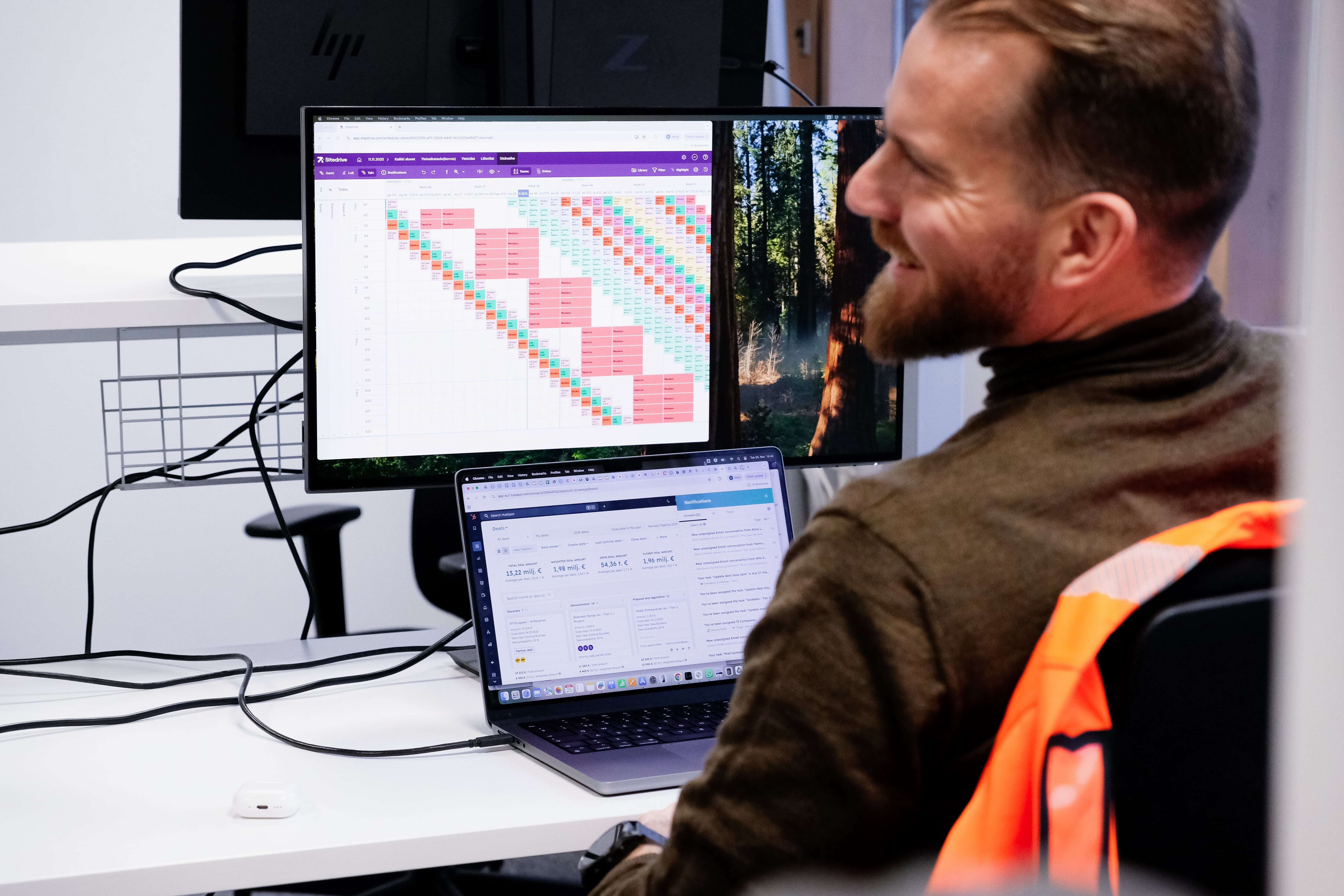
Antti Pukema, ou Account Executive in the Finland team believes the best onboarding gives new colleagues confidence early on – through shared customer meetings, real industry context, and learning together, not alone.
Onboarding is different depending on the role, and that’s okay
Each of us sees onboarding through their own lens.
Antti, who will be soon onboarding a new sales colleague starting in our Norway team, is focused on confidence:
“I want them to really understand the industry and the product. The terminology. The reality of construction projects.”
Not to control how sales is done, but to make sure they don’t feel like they’re being left alone in customer meetings. Also, sales at Sitedrive isn’t about following a rigid script. It’s conversational, evolving, and open to new input.
Sini talks about balance on the customer success side:
“There’s the ideological side, why we do what we do. And then there’s the very practical side: how we actually work day to day.”
She wants new colleagues to be brought into customer meetings early, without having to fight for space. To observe, learn, and slowly take ownership, without pressure to prove themselves instantly.
And Veera, onboarding a new marketing colleague, is focused on shared understanding:
“Of course, as a startup we’ve learned a lot the hard way. I want to pass those learnings on so no one has to reinvent the wheel.”
From ICP and customer insights to HubSpot usage and revenue collaboration, onboarding is about giving context. So new people can contribute faster and smarter.
Onboarding across countries requires extra care
Starting in a new role is one thing, but starting in a new team in a new country is another!
For our Norway hires, we’ve been talking a lot about presence, even when we’re not physically together.
Ideas like:
- A dedicated work buddy for informal check-ins
- Frequent 1:1s, especially early on
- Optional daily or weekly huddles for sales sparring
- Creating low-effort ways to “work alongside” each other remotely
“The goal is that the new colleague doesn’t just work for Sitedrive, but feels like part of the team, even from another country,” Anni says.
Feedback starts on day one (in both directions)
One theme keeps coming back for us: one of our big cultural focus points in 2026 will be developing our feedback culture.
By that we don’t mean performance reviews or formal checklists. Getting better at just giving honest, early, human feedback, is going to be valuable for us.
“When you start a new job, you’re always wondering if people are happy with your work, especially if no one says anything,” Veera says.
That’s something we want to avoid. We’re building our onboarding so that:
- Expectations for the first months are clear (and realistic)
- Positive feedback is given early and often
- Questions like “How are you doing?” and “What would you need more or less of?” are normal
- New colleagues are encouraged to challenge us, not just adapt to us
“You don’t have to absorb everything like a sponge. You’re allowed to shape Sitedrive’s culture with us,” Anni says.
What we hope new colleagues feel after week one
If onboarding has worked – even in its early stages – this is the feeling we’re aiming for:
a bit full of new information, sure. But above all, genuinely excited.
“We hope new colleagues feel warmly welcomed. That it’s clear we’ve truly been waiting for them,” Anni says.
“And that by Friday, the feeling is: ‘This is cool. And they’re actually happy I’m here,’” Antti adds.
Beyond that first-week feeling, we actively encourage new colleagues to be brave early on: to ask questions, to proactively book time with busy colleagues when they feel like they need it, and to say out loud when something feels unclear, inefficient, or simply odd.
As Veera puts it, new colleagues often see things most clearly, before habits form and assumptions settle in. That “outside” perspective is valuable to us.
We don’t expect people to quietly blend in or just learn “how things are done.” We expect – and genuinely want – new voices, new skills, new opinions, and new ideas to shape how Sitedrive evolves next.
Starting a new role is a rare moment where you can look at a company from the outside and inside at the same time. We see that as a strength, and a chance to improve – not something to smooth over.