
Early 2026 marks a clear shift for Sitedrive.
The product works. Customers are using it the way it was meant to be used. Feedback from new markets like Norway shows the same thing again and again: Sitedrive fits naturally into how construction teams actually plan, coordinate and run their work.
That didn’t happen by accident.
It’s the result of years of deliberate choices: testing different paths, letting go of things that didn’t create real value, and narrowing the focus to what truly matters on-site.
“We’ve now stripped everything unnecessary away,” says Henry Salo, CEO of Sitedrive. “Now we’re in an acceleration phase, but on a very specific path.”
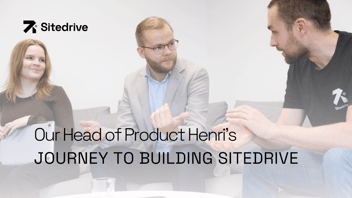
In this interview, Henry reflects on where the company is today, the decisions that brought it here, and the thinking behind Sitedrive’s vision for the years ahead. He talks about what truly differentiates construction SaaS in 2026 – from deep domain understanding and flow-based production to the role of the team and the everyday realities of work on-site.
What matters in construction SaaS in 2026
Construction is the world’s largest industry, yet much of its daily work is still coordinated through paper notes, phone calls and meetings.
“Millions of construction workers still don’t know, from any digital system, what they’re supposed to do today,” Henry says. “That alone tells you how much inefficiency there still is.”
The problem isn’t a lack of software, but a lack of practical coordination.
Today, buildings are designed with advanced digital tools, BIM models and digital twins. But the actual construction work – who does what, where and when – is often planned at such a high level that it doesn’t guide daily execution at all.
“The problems you see on-site are just a consequence of poor planning earlier on,” Henry explains. “Most sites are still planned at a level where no one really knows where they should be and what they should be doing.”
The result is visible everywhere. Streets in the Helsinki city centre dug open for months. Crews waiting for each other. Work happening out of sequence.
“This sounds obvious, but in construction it’s not,” Henry says. “Planning the building and planning the work are two very different things – and the second one is where productivity is usually lost.”
For Sitedrive, this is where everything starts. Not from technology for technology’s sake, but from the reality of coordinating thousands of people, tasks and locations – day by day, hour by hour.
3 things that differentiate Sitedrive: deep domain expertise, data and people working as one
Sitedrive’s differentiation in 2026 doesn’t come from a single feature. It comes from how deep domain understanding, construction logic and the team’s way of working come together.
#1 From deep domain expertise & construction logic to real impact on-site
At first glance, Sitedrive may look like a scheduling tool. In practice, it’s used just as much – or more – for daily site coordination.
“Many customers initially think they’re replacing an old scheduling tool,” Henry says. “Then they realise that most of the value comes from enabling precise, daily and even hourly coordination on-site.”
In Finland, this way of working is already relatively advanced. In other markets, it represents a significant cultural shift.
One concrete example is Hartela, a mid-sized construction company in Finland. By adopting flow-based production and using Sitedrive to coordinate work accordingly, Hartela was able to scale its production dramatically.
“They rolled the methodology out across the entire company,” Henry says. “The following year, Hartela became the largest residential builder in Finland by completed units.”
In Norway, the impact shows up differently. One large customer estimated that a single key user saves around 30 hours per month simply by not having to redraw schedules or search for information.
“Our client messaged us on Whatsapp saying: ‘Thanks for making our lives 100 times easier,’” Henry says. “That feedback stuck with us.”
It led to how Sitedrive now talks about its vision: helping construction professionals become 100 times happier and 100 times more productive.
“The point isn’t the number,” Henry adds. “It’s whether we truly understand what makes someone’s work that much easier – and whether we’re actually building towards that.”
#2 From point solution to platform built on real data
Another, less visible differentiator is data.
Sitedrive is one of the few platforms in construction where structured production data is created as a natural by-product of daily work: who did what, where, and when.
“That data becomes the foundation for everything else,” Henry explains. “In Finland, for example, other systems already rely on Sitedrive’s data as a starting point.”
This is also what enables Sitedrive’s long-term shift from a point solution to a platform – and what makes more advanced use of AI possible over time.
#3 The Sitedrive team behind everything – and why it matters
Technology alone doesn’t create this kind of differentiation. People do.
“What impresses me most about our team right now is their professionalism and self-direction,” Henry says. “I don’t need to explain what needs to be done – things move forward.”
Deep domain knowledge plays a critical role here.
“Having people who’ve actually worked on construction sites makes all the difference,” Henry says. “Without that, we’d just be guessing.”
Sitedrive deliberately works to avoid silos between product and revenue. Teams spend time together, talk constantly and treat the product not just as something to build, but as a core driver of customer value and growth.
“We don’t just develop features,” Henry says. “We think about how the product supports adoption, learning and ultimately revenue.”
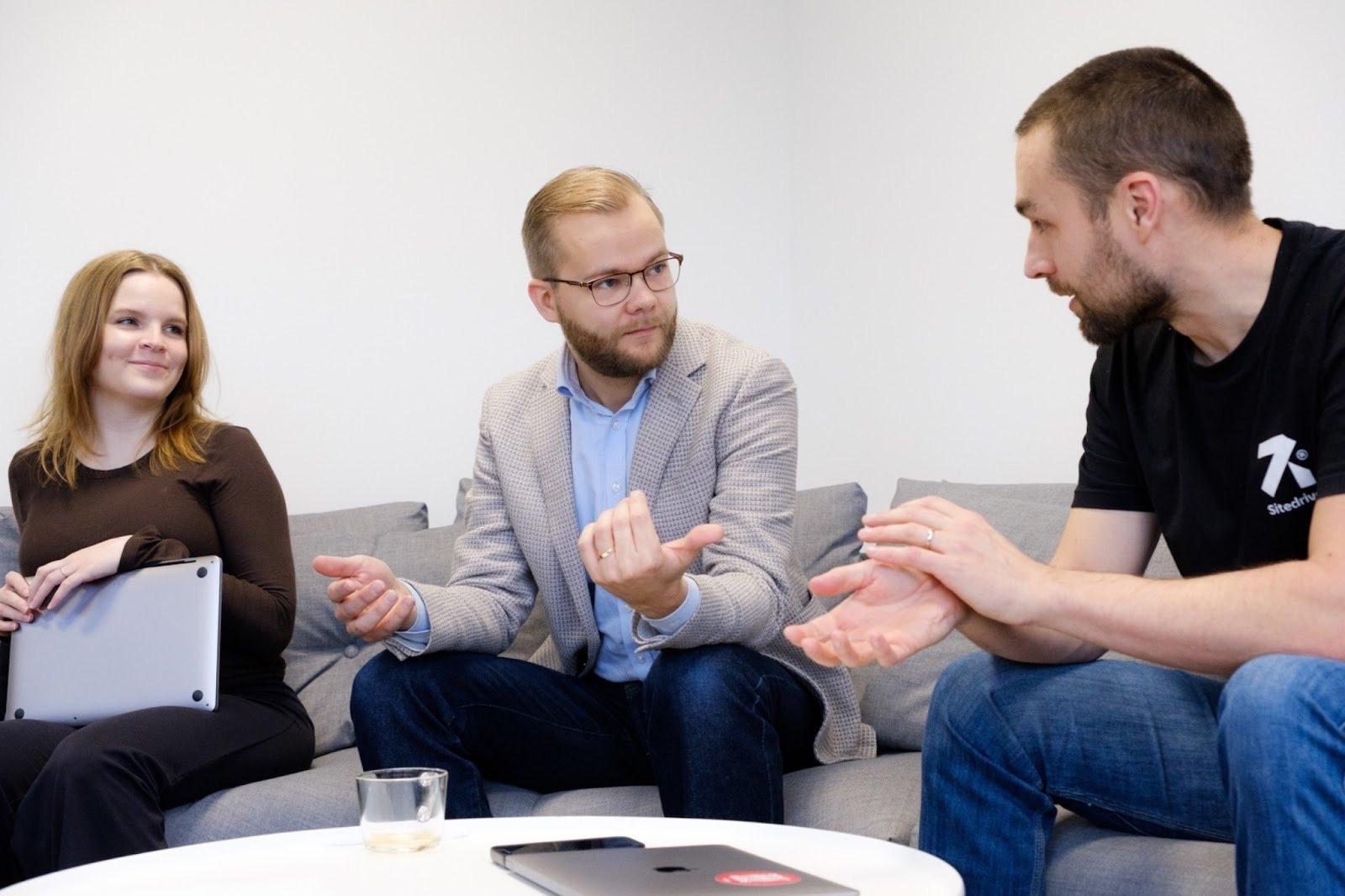
Henry says that our biggest competitive advantage is the team. People who understand construction deeply, take ownership of their work, and move things forward. “Without that, everything else would just be guesswork.”
Building Sitedrive’s future responsibly – growth, AI and the human side of leadership
AI is already changing how Sitedrive works – but not in the way hype often suggests.
“AI has completely changed how we build the product,” Henry says. “It’s multiplied our output and raised people’s capabilities.”
In product development, AI has enabled parallel work streams and shifted focus towards guiding and validating what’s being built, rather than doing everything manually.
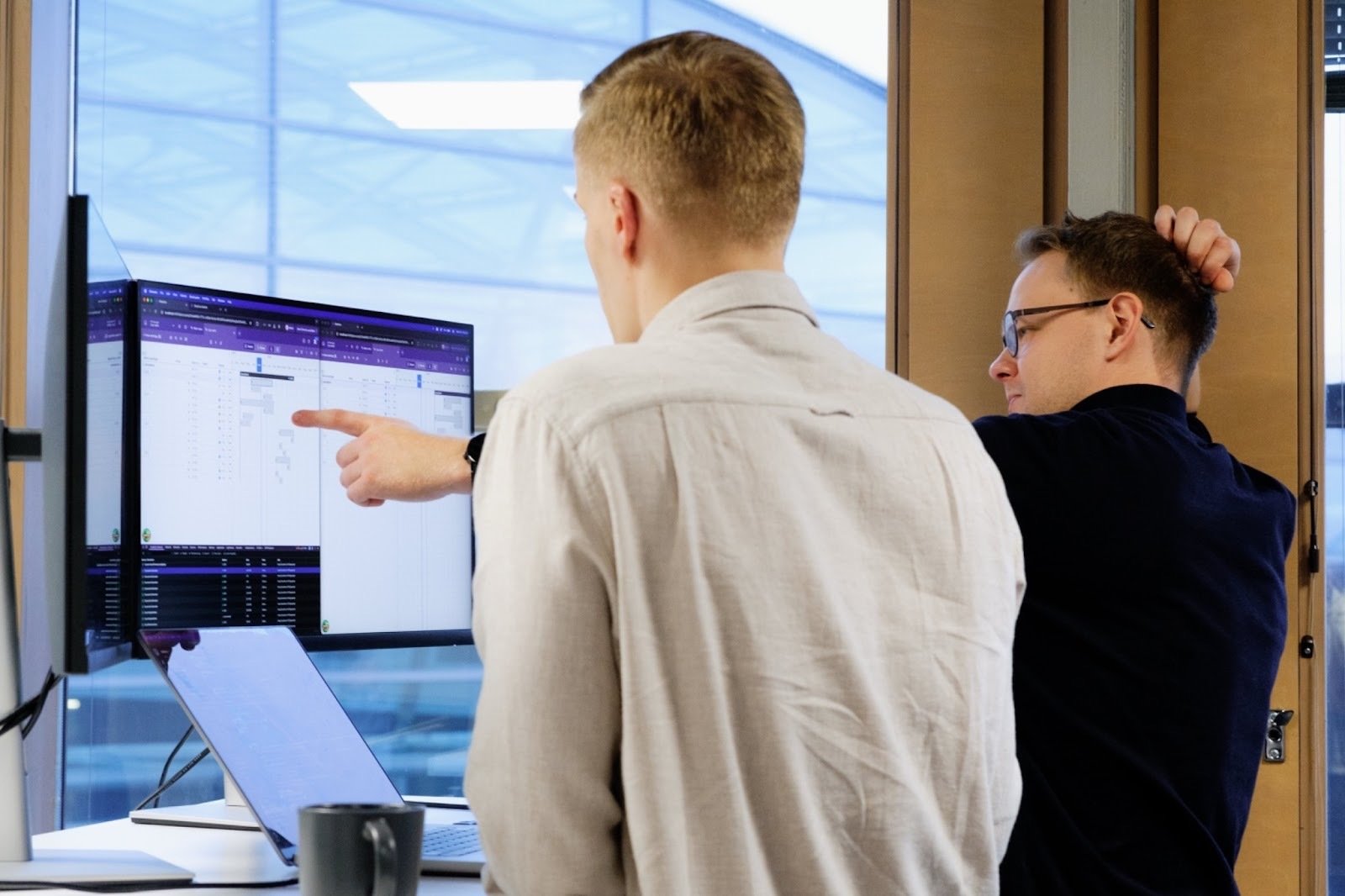
In product development, AI has enabled parallel work streams and shifted focus towards guiding and validating what’s being built, rather than doing everything manually.
On the customer side, progress is more gradual. Construction as an industry still lacks the volume of structured data needed for advanced AI applications.
“That’s the biggest bottleneck,” Henry says. “And it’s exactly why building that data foundation matters so much.”
In early 2026, Sitedrive is taking a concrete step forward by introducing AI-supported schedule generation. Instead of drawing schedules from scratch, customers can provide key inputs and receive a proposed plan that can then be refined.
“Things that used to take days can be done in minutes,” Henry says. “That fundamentally changes how projects start.”
Growth, however, is approached with discipline.
“Our biggest risk as a startup is growing too fast,” Henry says. “Cash flow matters, especially when you expand into new markets where sales cycles are long.”
This realism also shapes Henry’s view on leadership.
“I measure my own success through the success of my colleagues,” he says. “If people grow, succeed and feel proud of the work they did here, that’s what matters most.”
Leadership, in Henry’s view, also means addressing difficult issues early.
“Everyone notices when something isn’t working,” he says. “Leadership is about being the one who dares to say it out loud and bring it to the table.”
Looking ahead five years, Henry sees Sitedrive operating globally, present in the most relevant construction markets, known for flow-based production and precise site coordination. But the goal isn’t just scale.
“I hope no one in the team is burned out,” he says. “That our people look back and say this was meaningful – and that it was actually fun.”
There is one thing Sitedrive won’t compromise on along the way.
“Trust,” Henry says. “Ethics, transparency and how we handle our customers and money. Those aren’t negotiable.”
In an industry that builds the physical world around us, that mindset matters.
For Sitedrive, the journey ahead is about building something that lasts:
- Flow-based production as a practical methodology used globally,
- Precise site coordination as a daily site reality, and
- A platform that helps construction teams work better. And makes them 100 times happier.
Not in theory, but in real projects, every day.